

10–12 Inch Rule: Measure Dining Chair Height, Test in Showroom
Use the 10-12 inch rule: your chair seat should sit about 10 to 12 inches below the underside of your table. For a standard table (28-30 inches tall), that means a seat height of 17-20 inches. Counter-height tables (34-36 inches) call for a 24-26 inch seat, and bar-height tables (40-42 inches) need 28-30 inches. Just remember cushions compress and armrests need clearance too.
TL;DR:
- Chairs with a seat height of 17-20 inches are best suited for standard dining tables that are 28-30 inches tall, following the 10-12 inch clearance rule.
- Cushions compress by about 1-2 inches under weight, so the actual comfortable seat height often runs 1-2 inches lower than the listed measurement.
- Measure your table’s underside height from the floor to the lowest point under the tabletop for accurate fit; subtract 10-12 inches to determine your target chair seat height range.
- Armrests taller than your table’s underside can prevent chairs from sliding in fully, but slight frame modifications can often resolve this fit issue.
- Testing chairs in person, pressing cushions, and checking elbow clearance at the table are essential steps for ensuring the optimal, comfortable fit.
Table of Contents
- Dining Chair Height Guide: Quick Reference Chart by Table Type
- How to Measure Your Table and Chairs Correctly
- Cushions, Upholstery and Armrests: Common Fit Issues and Fixes
- Seat Depth, Seat Width and Posture: Comfort Beyond Height
- Mixing Chairs, Benches and Stools: Design Rules That Keep Fit Consistent
- Shopping Checklist: What to Check on Specs and in the Showroom
- Why Showroom Testing and Customization Matter
- Considerations for Different User Heights: Children vs. Adults
- The Impact of Chair Leg Design on Usable Height
- Author Perspective: Practical Rules That Save Time When Shopping
- How cozyhome Helps: Custom Dining Chairs and In-Showroom Fittings
- Sources
- FAQ
Dining Chair Height Guide: Quick Reference Chart by Table Type
Every table style has its own sweet spot for seat height, and the 10-12 inch clearance rule stays constant across all three. What changes is the table height itself, which shifts the whole range up or down the ladder.
| Table Type | Typical Table Height | Recommended Seat Height | Common Use Case |
|---|---|---|---|
| Standard dining | 28-30 in | 17-20 in | Family dinners, formal dining rooms |
| Counter height | 34-36 in | 24-26 in | Breakfast nooks, kitchen islands |
| Bar height | 40-42 in | 28-30 in | Home bars, high-top entertaining spaces |
We source these ranges from established guidance on dining chair sizing and from height-specific breakdowns for counter and bar setups from Dutch Craft Furniture.
If your table falls outside these standard numbers, the chart still works. Just take your table’s actual underside height and subtract 10 to 12 inches. A 32-inch table (a common in-between height for some custom pieces) gives you a target seat height of 20-22 inches. This simple subtraction is the backbone of the whole system, and once you’ve done it once, you’ll never eyeball a dining chair purchase again.
How to Measure Your Table and Chairs Correctly
Getting this right takes five minutes and a tape measure. Skip the guesswork and measure both pieces the same way every furniture designer does.
- Measure the table’s underside height. Place your tape measure on the floor and extend it straight up to the lowest point under the tabletop, which is usually the apron (the structural frame just under the surface) rather than the tabletop itself. This is your true clearance ceiling, and measuring the underside rather than the surface is where most shoppers go wrong.
- Measure the chair’s seat height. Measure from the floor to the top of the seat at its front edge. For upholstered chairs, press down firmly with your palm to simulate a person’s weight before you take the reading.
- Apply the formula. Subtract 10 to 12 inches from your table’s underside measurement. That result is your target seat height range, and any chair that falls inside it should clear your table comfortably.
- Run the in-showroom checklist. Sit down, rest your elbow on the tabletop, and check that your forearm sits at a relaxed, roughly 90-degree angle. Slide the chair fully under the table to confirm the armrests (if any) pass under the apron without catching.
A quick shortcut, borrowed from ergonomics work outside the dining room: some seat-height calculators recommend subtracting roughly 10 inches from the work surface height to find a workable midpoint, then adjusting about 2.5 inches in either direction depending on the chair. It’s a handy cross-check if your own math ever feels off.
Pro Tip: Write your table’s underside height and your target seat range on your phone before you walk into a showroom. It sounds simple, but it saves you from falling in love with a chair that’s an inch too tall to slide under your table.
Cushions, Upholstery and Armrests: Common Fit Issues and Fixes
A chair’s listed seat height rarely tells the whole story once someone actually sits down. Upholstered cushions compress by about 1 to 2 inches under a person’s weight, which means the “functional” seat height, the one that matters once someone is seated, can run noticeably lower than the spec sheet suggests. Armrests cause a different kind of headache: if the arm height is taller than your table’s apron clearance, the chair simply won’t slide in.
Here’s what tends to go wrong, and how to fix it:
- Cushion compression surprise: A chair listed at 19 inches may sit at 17.5 inches once someone’s weight settles in. Press the cushion firmly or sit for a few seconds before measuring.
- Armrests that hit the apron: Measure from the floor to the top of the armrest and compare it against your table’s underside height, leaving at least 0.5 to 1 inch of margin so the chair slides freely.
- Mismatched cushion thickness across a set: Swapping a firmer or thinner cushion insert can shave off half an inch without changing the chair’s frame.
- Armchairs that simply won’t fit: Side chairs (no arms) are the safer bet for tighter table heights. Save armchairs for the ends of the table where clearance is less of an issue.
Pro Tip: If you love a chair but its arms won’t clear your table, ask about custom seat height adjustments before you write it off. A half-inch change in the frame can solve a fit problem that seemed like a dead end.
Seat Depth, Seat Width and Posture: Comfort Beyond Height
Height gets most of the attention, but seat depth and width shape how a chair actually feels once you’re sitting in it for a two-hour dinner. A seat that’s too deep pushes your knees up and makes it awkward to stand, especially paired with a low seat height; a seat that’s too shallow leaves your thighs unsupported and your back working overtime.
- Seat depth: Most dining chairs run 16-18 inches deep, which suits average adult proportions without crowding the knees or leaving a gap behind the thighs.
- Standing clearance: Deep seats combined with low seat heights (think 17 inches) make it harder to push up and stand, since your center of gravity sits further back over the chair.
- Space per person: Plan for roughly 24 inches of width per side chair and 28-30 inches for armchairs, which keeps elbows from bumping into neighbors mid-meal.
- Pairing depth with table type: Counter and bar stools tend to run slightly shallower than standard dining chairs, since taller seating naturally shifts weight forward and reduces the need for deep thigh support.
Getting seat width right matters just as much for a crowded holiday table as seat height does. Cramped elbow room registers as discomfort even when the chair height is perfect, so measure your table’s total length against your headcount before finalizing a purchase.
Mixing Chairs, Benches and Stools: Design Rules That Keep Fit Consistent
Mixing seating styles at one table looks great in photos, but it only works if the finished heights actually line up. Designers generally recommend keeping seat heights within 0.5 to 1 inch of each other across a mixed set, since anything wider than that becomes noticeable the moment someone sits down.
- Measure bench height the same way as chairs. Benches often have thinner or fixed cushions that compress less than upholstered chairs, so their functional height can run higher than expected.
- Don’t mix bar stools with a standard table. A 40-inch bar stool at a 30-inch table puts knees well above the tabletop, which defeats the whole point of the clearance rule.
- If you want intentional height variation (say, a bench for kids at one end), stage it deliberately and confirm each seat still clears the table’s apron on its own terms.
- Test the full set together, not chair by chair, since small variances between individual pieces add up fast around a shared table.
Shopping Checklist: What to Check on Specs and in the Showroom
Online spec sheets are a starting point, not the final word. Some numbers you can trust at face value; others need a hands-on check before you commit.
- Verify seat height is listed unloaded. Manufacturers rarely state whether a seat height number reflects the cushion before or after compression, so ask directly.
- Confirm arm height against your table’s clearance. This single number causes more returns than almost any other spec mismatch.
- Check seat depth and width against your table’s headcount plan. A chair that’s comfortable alone can still crowd a full table.
- Press the cushion and sit for a full minute or two in the showroom. A quick perch tells you nothing about how the chair feels after twenty minutes of dinner conversation.
- Run the elbow test at the actual table, resting your forearm on the surface to check for a natural, relaxed angle.
- Ask for the finished seat height in writing, meaning the number after upholstery and cushioning are accounted for, before you finalize an order.
- Confirm return or exchange policy on custom pieces, since made-to-order seating can’t always be swapped as easily as stock inventory.
Why Showroom Testing and Customization Matter
Some furniture showrooms are built around a simple belief: numbers on a spec sheet only tell you so much. You can measure your table underside to the eighth of an inch, but you still need to sit down, press the cushion, and rest your elbow on the tabletop before you know a chair actually works in your dining room.
The 10-12 inch rule gives you a starting range, not a guarantee. The only way to know a chair truly fits is to test it against your own table, with your own weight settled into the cushion.
That’s why some teams walk customers through fabric, sizing, and configuration in person rather than pointing them at a spec sheet and hoping for the best. Because some dining seating is made-to-order, finished seat height or cushion firmness can be adjusted within a workable range to hit a target number exactly, instead of forcing a compromise between “close enough” and “actually comfortable.” If you’ve already measured your table at home, bring those numbers with you. It turns a showroom visit from browsing into a fitting.
Considerations for Different User Heights: Children vs. Adults
The 10-12 inch rule is built around average adult proportions, but it stretches or shrinks depending on who’s actually sitting down. Adults generally feel most comfortable with knees at roughly a 90-degree angle and feet flat on the floor, which is exactly what the standard 17-20 inch seat height range is designed to deliver at a 28-30 inch table.
Kids are a different story. A standard 18-inch seat height leaves most children under age eight with their feet dangling well above the floor, which strains circulation and makes it harder to sit still through a meal. Booster seats or a slightly shorter dedicated kids’ chair close that gap without forcing you to buy a second table. If your household regularly seats a mix of adults and young children, look for dining chair sets that offer a booster option or a junior chair sized to roughly 14-15 inches, which brings feet closer to the floor while keeping the tabletop at the same standard height for everyone else.
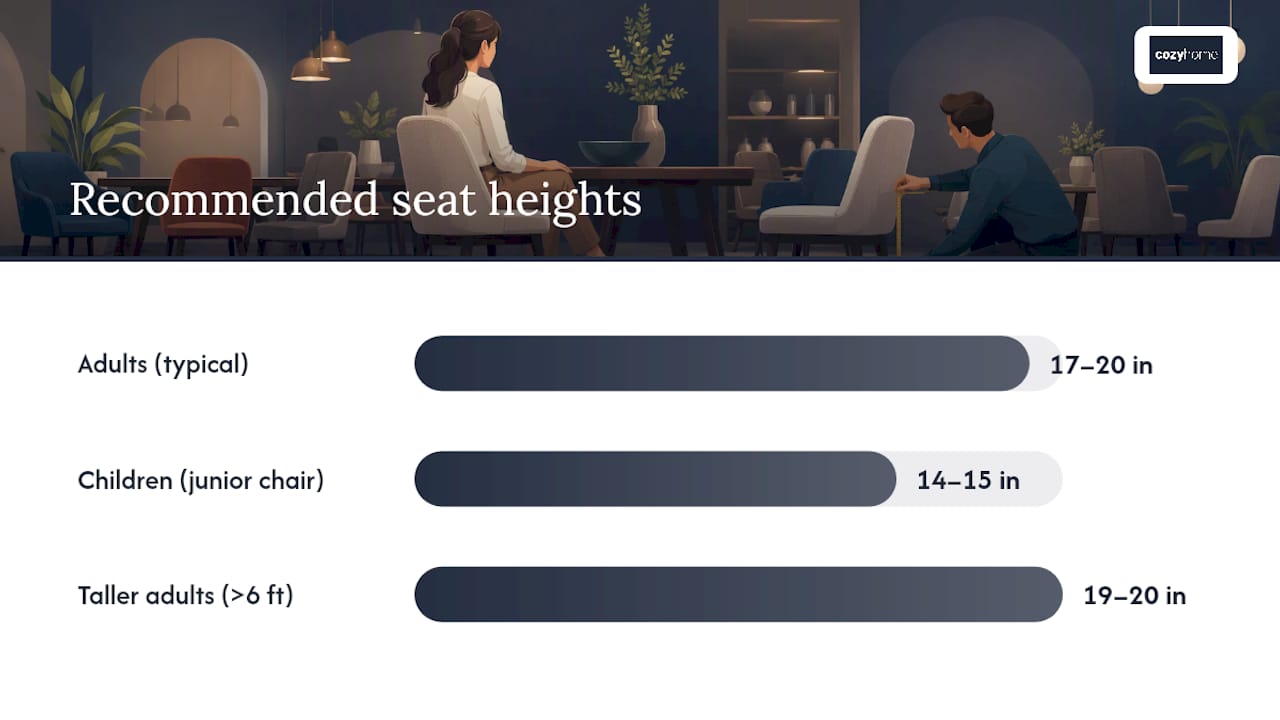
Taller adults, meanwhile, sometimes need to size up toward the higher end of a range rather than the midpoint. Someone over six feet tall often prefers a 19-20 inch seat rather than a 17-inch seat, even at a standard table, simply because longer legs need more clearance to avoid a cramped, knees-up posture. The rule still applies. It just shifts within the given range based on who’s actually sitting in the chair.
The Impact of Chair Leg Design on Usable Height
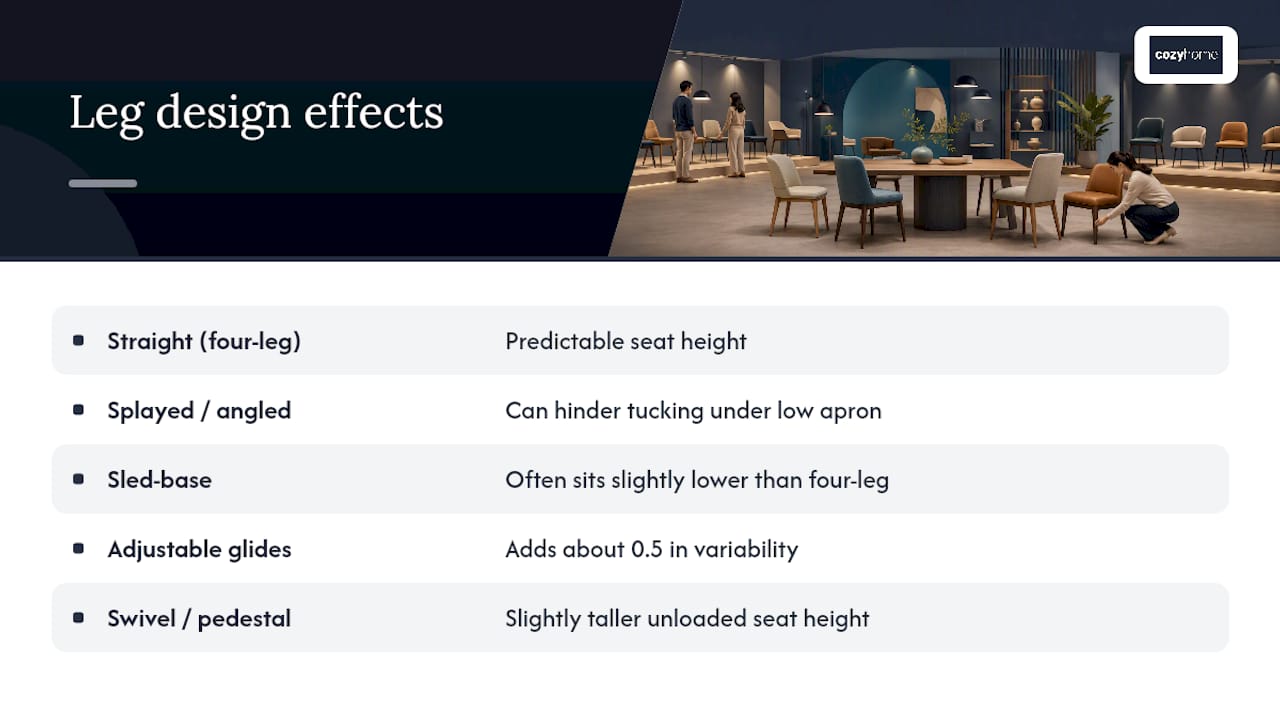
Not all chair legs deliver the seat height printed on the tag, and leg design is the quiet variable that trips up a lot of shoppers. Straight, four-legged chairs are the most predictable: what you measure is what you get, with no hidden variables between the floor and the seat.
Splayed or angled legs, common on mid-century and Scandinavian-style chairs, can shift the effective footprint of a chair even when the seat height stays the same, sometimes making it harder to tuck the chair fully under a table with a low apron. Sled-base chairs, where the legs curve into a continuous runner rather than four separate points, often sit slightly lower than a comparable four-leg design because the curved base absorbs a bit of the vertical rise.
Chairs with adjustable or leveling glides built into the feet add another half inch of variability, which matters if your dining room has an uneven floor or you’re trying to match a mixed seating set. And swivel or pedestal-base chairs, more common at counter and bar heights, sometimes carry a slightly taller unloaded seat height than their spec sheet suggests, since the mechanism itself adds a fraction of an inch before anyone even sits down.
The practical takeaway: leg design won’t change which range you’re targeting, but it can shift where a specific chair actually lands within that range. When in doubt, measure the finished piece in person rather than trusting the design category alone.
Author Perspective: Practical Rules That Save Time When Shopping
The 10-12 inch rule isn’t a suggestion. It’s the one number that decides whether a chair actually works at your table, and everything else, style, fabric, armrests, is secondary until that clearance checks out.
My honest recommendation: write your table’s underside measurement down before you shop, not after you’ve already fallen for a chair online. Bring that number with you, press every cushion you’re considering, and sit for longer than ten seconds. A chair that feels fine standing next to it can feel completely wrong once you’re seated for a full meal.
Looks matter, but only after fit does. Get the range right first, and the styling decisions get a lot easier.
— Dean P.
How cozyhome Helps: Custom Dining Chairs and In-Showroom Fittings
Getting the math right on paper is one thing. Sitting in the actual chair, at the actual height, with the cushion actually compressed, is what tells you whether it works. This gap can be closed by showrooms that allow customers to test the fit in person and adjust before purchase.
Bring three things to your visit: your table’s underside height, the seat height of any chairs you’re replacing, and a photo of your dining space if you have one. Our team will walk you through fabric and frame options for chairs like the Owing dining chair or the Frankie dining chair, checking seat height and cushion firmness against your actual measurements rather than a generic size chart. If you’re also considering a new table, our custom dining table options can be built to a height that pairs perfectly with the chairs you already love.
Ready to see how it fits? Browse dining chairs online or schedule a showroom fitting to test seat height and cushion feel before you order.
Sources
The measurements and ranges in this guide draw from a few reliable references worth bookmarking. Elirian’s dining chair height guide covers standard seat height ranges in detail. Ashdeco’s breakdown of the 10-12 inch rule explains the clearance math clearly. For a more technical approach borrowed from ergonomics work, Bevco’s seat height calculator guidance offers a useful cross-check formula. Dutch Craft Furniture’s complete guide to table and chair heights rounds out the counter and bar height specifics.
- Dining Chair Height Guide: How to Choose the Right Size – Elirian
- The 10–12 Inch Rule: How to Pick Dining Chairs That Actually Fit – Ashdeco
- Determining seat height – Bevco (Seat Height Calculator and ergonomics guidance)
FAQ
What Is the Ideal Seat Height for a Dining Chair?
For a standard 28-30 inch dining table, the ideal seat height falls between 17 and 20 inches, following the 10-12 inch clearance rule. Counter and bar tables shift that range higher, to 24-26 inches and 28-30 inches respectively.
Is 17 Inches Too Short for a Dining Chair?
No, 17 inches sits at the lower end of the standard range and works well for taller tables or shorter individuals. It only feels too short if your table underside measures much less than 28-30 inches, which would leave more than 12 inches of clearance.
What Is the Recommended Chair Height for a 30-Inch Dining Table?
For a 30-inch table, subtract 10 to 12 inches to land on a target seat height of 18 to 20 inches. This keeps you within the standard seat height range most manufacturers design around.
What Is the Seat Height of a 16-Inch Dining Chair?
A chair listed at 16 inches sits below the typical standard range and would pair better with a shorter table, around 26-28 inches, to preserve the 10-12 inch clearance. At a full 30-inch table, a 16-inch chair would leave an unusually wide 14-inch gap, which usually feels too low for comfortable dining.