

Protect Your Furniture: Buy Kiln Dried Wood at 6–8% Moisture
Kiln dried wood is lumber or firewood dried in a controlled chamber that uses heat, humidity control, and airflow to bring moisture content down to a specific target instead of leaving it to the weather. For furniture and millwork, that target usually lands in a low single-digit moisture content range, which keeps joints tight and finishes stable long after the piece leaves the shop. For firewood, kiln drying means a hotter, cleaner burn that allows usage shortly after purchase.
TL;DR:
- Kiln drying reduces wood moisture content to 6-8% for furniture and millwork, ensuring stability and tight joints in heated indoor environments.
- The drying process involves staged equalization, active drying with controlled temperature and humidity, and final conditioning to prevent warping and internal damage.
- Proper testing with moisture meters and asking suppliers for documentation ensures the wood is truly kiln dried and ready for craftsmanship.
- A hybrid approach of air drying followed by kiln finishing can lower costs and drying time while maintaining stability.
- Store kiln-dried wood properly with ventilation and acclimate it inside to prevent moisture absorption before final use.
Table of Contents
- What Does “Kiln Dried” Actually Mean?
- How Kiln Drying Works, Step by Step
- Why Kiln Schedules Exist and What Goes Wrong Without Them
- Kiln Dried vs Air Dried: Which One Fits Your Project?
- What Moisture Content Should You Target?
- How Do You Test and Confirm Wood Is Actually Kiln Dried?
- Where to Buy Kiln Dried Wood and What to Ask Sellers
- How to Store Kiln Dried Wood Without Ruining It
- Can You Kiln Dry Wood at Home?
- A Showroom Perspective on Why This Actually Matters to Furniture Buyers
- See Kiln Dried Wood Craftsmanship in Our Showroom Pieces
- Sources
- FAQ
What Does “Kiln Dried” Actually Mean?
“Kiln-dried” gets used loosely at lumber yards and firewood stands, so it helps to know what the term is supposed to guarantee. Kiln-dried wood has been processed in a heated chamber to a specified moisture content, verified by testing rather than guesswork. Air-dried lumber, by contrast, loses moisture naturally in a covered stack outdoors, typically settling into the 14% to 25% range depending on climate and species. “Shipping-dry” or “surface-dry” wood is a third category worth knowing. It feels dry to the touch but may still carry moisture content well above what is suitable for fine woodworking, which is exactly the kind of material that warps after it reaches your shop.
Trade labels add another layer. You’ll see grade stamps like KD15, which means kiln-dried to a moderate maximum moisture content common for framing lumber. Some hardwood suppliers reference much lower moisture contents for furniture-grade stock, signaling the tighter range cabinetmakers need. The USDA Forest Products Laboratory’s Wood Handbook lays out the industry logic behind these numbers, and it breaks down fairly cleanly by end use:
- Furniture and millwork: 6% to 8% moisture content, because indoor heated environments pull wood drier than almost any outdoor setting.
- Appearance-grade softwoods: roughly 10% to 12%, balancing stability with cost.
- Framing lumber: averages around 15%, not to exceed 19%, since structural wood tolerates more movement.
- Firewood: generally under 20%, the threshold where combustion turns efficient instead of smoky.
The specification matters most at the joinery stage. Wood that’s too wet when you glue, cut, or finish it will shrink afterward, opening seams and cracking paint or stain. A stove loaded with wood above 20% moisture wastes a good portion of its heat just boiling off water before the fire ever reaches full temperature.
How Kiln Drying Works, Step by Step
Kiln drying isn’t just “baking wood until the water’s gone.” It’s a staged process built around one central problem: wood loses moisture from its surface faster than its core can catch up, and if you rush that mismatch, the board cracks, warps, or develops hidden internal damage. The whole schedule exists to manage that gap.
Equalization comes first. Freshly loaded lumber sits in a controlled environment where temperature and relative humidity are held steady long enough for moisture to even out across each board, corner to core. Skipping this stage is the single most common cause of drying defects, according to Oklahoma State University Extension, because it sets up the internal moisture gradient that causes trouble later.
Active drying follows. This is the phase most people picture when they think of a kiln: heaters raise the temperature, vents and dampers control humidity, and fans push air through the stack fast enough to carry moisture away without stripping the surface too quickly. Operators raise temperature and drop relative humidity in stages, never all at once, because a sudden shift shocks the wood.
Final conditioning closes out the cycle. Steam or added humidity gets reintroduced briefly to relieve any stress that built up during active drying, softening the outer shell so the whole board settles at a uniform moisture content rather than a dry shell wrapped around a wetter core.
Three variables run the whole show:
- Temperature speeds up moisture movement but raises the risk of surface damage if pushed too fast.
- Relative humidity controls how aggressively the kiln pulls moisture, and it drops in planned stages rather than a straight line down.
- Airflow carries moisture out of the chamber and keeps drying even across every board in the stack, not just the ones nearest the fan.
Kiln types vary by scale and budget. Conventional steam kilns are the workhorses of commercial lumber production, using heated air and steam injection for the fastest, most controllable results on high volumes. Dehumidification kilns run cooler and slower, pulling moisture out with refrigeration coils instead of steam, which makes them cheaper to operate for smaller mills. Vacuum kilns dry wood under reduced atmospheric pressure, which speeds up moisture movement dramatically and suits thick or dense hardwood that would otherwise take weeks. Solar kilns use greenhouse-style heat gain and are mostly a small-shop or hobbyist option, slower than the others but far cheaper to build.
Pro Tip: If a supplier can’t tell you whether their kiln uses steam or dehumidification, ask how long their typical cycle runs. Long cycles for thin stock (over three weeks for one-inch hardwood) often signal an underpowered dehumidification setup rather than a problem with the wood itself.
Why Kiln Schedules Exist and What Goes Wrong Without Them
A kiln schedule is a written plan mapping out exactly how temperature and relative humidity change over the course of a drying cycle, adjusted for species, thickness, and grade. Operators don’t just crank the heat and wait. They follow a curve, because wood under uneven drying stress develops internal damage long before it looks damaged from the outside.
The defects a poor schedule causes tend to fall into a few recognizable patterns:
- Surface checking shows up as small cracks on the face or ends of a board, usually from drying the surface too fast relative to the core.
- Honeycombing is internal cracking you can’t see until the board is ripped or milled, caused by stress that built up during rushed drying and never released.
- Collapse happens when cell walls cave in under drying stress, leaving a board that looks fine but measures thinner and weaker than it should.
Kiln operators lengthen or compress a schedule based on a few practical factors. Thicker stock always takes longer, since moisture has farther to travel from the core to the surface. Dense hardwoods like oak and hard maple dry more slowly and need gentler humidity steps than a softwood like pine, which tolerates faster schedules without cracking. Higher grade lumber, where clean, defect-free surfaces matter for appearance, gets a more conservative schedule even if it costs extra kiln time. That’s the trade the whole industry makes: speed against risk, every single cycle.
Kiln Dried vs Air Dried: Which One Fits Your Project?
Kiln drying wins on speed and control; air drying wins on cost and simplicity. The right choice depends on whether you’re building furniture that has to stay tight for decades or burning firewood by next winter.
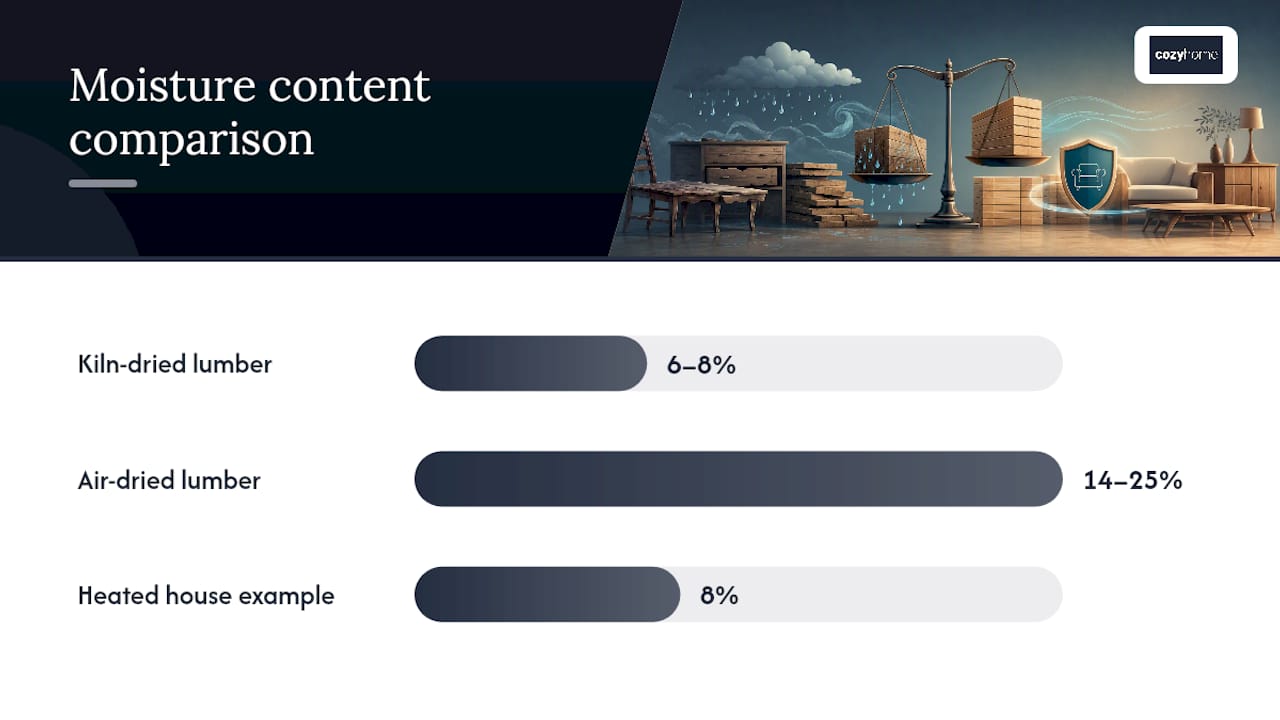
Air-drying lumber costs next to nothing beyond stickers and stack space, but it takes real patience. Timelines run anywhere from 60 days to more than 320 days depending on species and board thickness, and even after all that time, the wood typically bottoms out around 14% to 25% moisture content in most climates. That’s fine for framing or rough outdoor projects. It’s not fine for a dining table that’s going into a heated house at 8% ambient humidity, because the wood will keep shrinking after you’ve already built and finished it.
Kiln drying solves that gap by pushing moisture content below what air alone can reach, which is exactly why furniture shops specify 6% to 8% rather than accepting whatever the weather gives them.
| Factor | Kiln Dried | Air Dried |
|---|---|---|
| Typical timeline | Days to a few weeks | Months to over a year |
| Achievable moisture content | Down to 6% to 8% | Usually 14% to 25% |
| Cost | Higher (energy, equipment) | Low (time and space only) |
| Pest and mold control | Heat kills insects and mold spores | Limited; pests can persist |
| Best for | Furniture, millwork, firewood ready to burn | Framing, outdoor projects, pre-drying step |
A hybrid approach is standard practice at many commercial operations. Air-drying green lumber down to around 20% to 25% first, then finishing in a kiln, cuts energy costs and kiln time substantially compared to loading green wood straight into the chamber. If you’re starting from freshly cut logs and need furniture-grade stock fast, skipping straight to a full kiln cycle from green is usually worth the extra energy cost.
What Moisture Content Should You Target?
The right target depends entirely on where the wood ends up, and getting this number wrong is the single most common reason finished woodworking projects fail months after completion. The USDA Wood Handbook sets recommended moisture content for wood used in interior heated buildings, and the numbers vary more than most buyers expect.
- Furniture and millwork: 6% to 8% moisture content, matching the low humidity most heated homes maintain in winter.
- Appearance-grade softwood trim: roughly 10% to 12%.
- Framing lumber: averages 15%, with 19% as the ceiling under most grading rules.
Equilibrium moisture content, or EMC, is the moisture level wood naturally settles at when it’s been exposed to a given temperature and relative humidity long enough to stop gaining or losing water. Your region and your home’s HVAC setup both shift that number. A house in Phoenix running dry winter heat pulls wood drier than a humid coastal home that runs air conditioning most of the year, so a furniture shop building for both markets has to think about the client’s actual environment, not just a generic rule of thumb.
One practical tolerance rule from furniture shops: specify a target moisture content about 1% lower than the expected service EMC, according to the Wood Handbook’s guidance on dimensional stability. That buffer accounts for the small moisture gain that happens during machining, sanding, and assembly, keeping the finished piece inside spec even after handling.
Grade marks like KD15 tell you the ceiling, not the exact number, so always ask for the actual tested figure when buying furniture-grade hardwood.
How Do You Test and Confirm Wood Is Actually Kiln Dried?
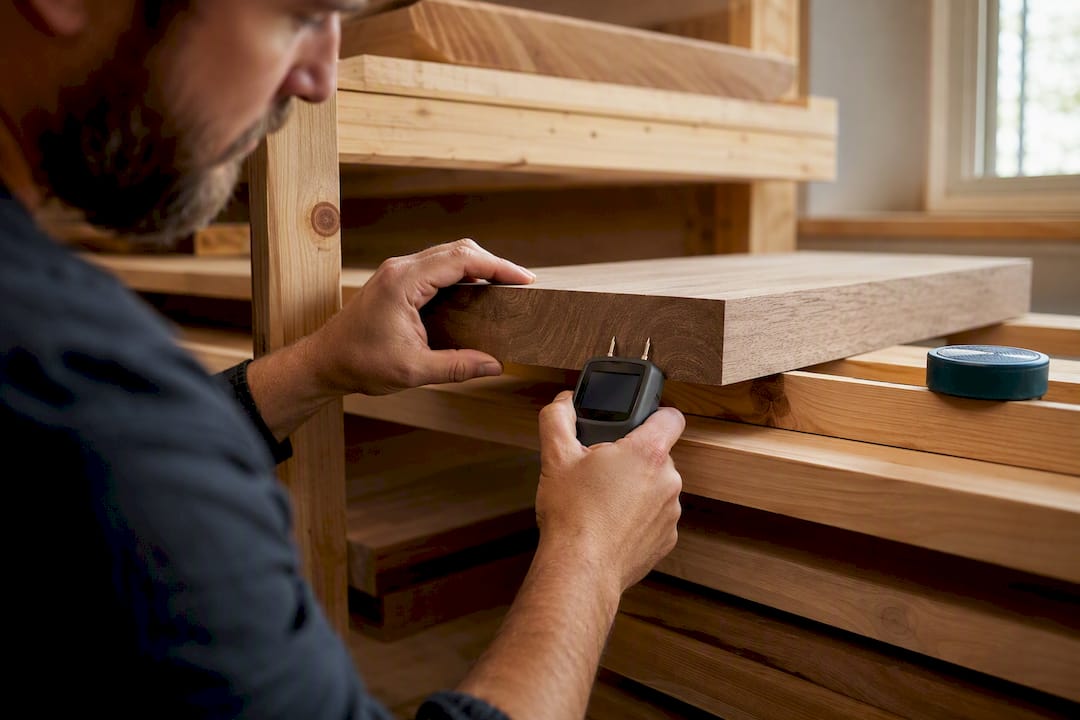
- Buy or borrow a moisture meter. Pin meters push two small probes into the wood and read resistance between them, giving you an accurate reading at whatever depth you insert the pins. Pinless meters use electromagnetic sensors pressed against the surface, faster and non-marring but slightly less precise on thick stock.
- Test more than one spot per board. Check both ends and the middle, since kiln-dried lumber can still carry moisture gradients if a batch wasn’t fully equalized.
- Use the sample-board method for larger orders. Weigh a sample board, dry it further in a home oven at low heat, then reweigh it to calculate actual moisture content as a check against the supplier’s claim.
- Ask for the batch testing method, not just a percentage on a tag. A seller who can describe how they test (meter type, sample size, testing point in the process) is more credible than one who just hands you a number.
- Request documentation for firewood labeled “Ready-to-Burn” or similarly certified, since that designation ties to a tested moisture ceiling rather than a marketing phrase.
Red flags worth walking away from: a seller who can’t name the moisture content at all, lumber that feels heavier than it should for its species, or firewood stacked in direct rain with no cover.
Pro Tip: Test kiln-dried lumber again after it sits in your shop for a week. If the reading climbed more than a point or two, your shop’s humidity is fighting the wood, and you need to acclimate longer before you build with it.
Where to Buy Kiln Dried Wood and What to Ask Sellers
Sourcing depends on what you’re building and how much control you need over the final moisture number. Sawmills with in-house kilns offer the most transparency, since you can often ask directly about their schedule and testing method. Specialty hardwood yards stock a wider range of species already dried to furniture-grade targets, useful when you need book-matched or figured stock that a generic mill won’t carry. Reclaimed wood dealers sell material with a history, but always confirm it’s been re-dried in a kiln, since old barn wood can carry pests or moisture levels far outside furniture spec. Firewood vendors range from backyard operations to certified suppliers, and the certification gap between them is significant.
Questions worth asking every seller before you buy:
- What species is this, and what was the target moisture content for this batch?
- How do you test moisture content, and can you show me a reading on this specific stock?
- What’s your return policy if a moisture meter reading comes back outside spec?
- For lumber, was this air-dried first and finished in a kiln, or dried from green?
Pricing reflects the extra energy and time kiln drying requires. Kiln-dried hardwood typically commands a premium over air-dried or green stock of the same species, and firewood sold as kiln-dried usually costs more per cord than seasoned wood sold by the same yard. Factor in delivery and handling too. Lumber that gets rained on during transport can pick moisture back up fast, so ask how a supplier ships and covers loads before you commit to an order. When you’re shopping for finished furniture rather than raw lumber, the craftsmanship standards behind a piece matter just as much as the wood species itself.
How to Store Kiln Dried Wood Without Ruining It
Kiln-dried lumber and firewood both need storage that keeps moisture out without sealing off airflow entirely.
- Store lumber raised off the ground on stickers, never directly on concrete or soil, which wick moisture upward.
- Cover the stack against rain and direct sun, but leave the sides open so air still circulates around the wood.
- Space stickers consistently through the stack. Misaligned stickers cause boards to bow even after the wood is already dry.
- Acclimate lumber inside your shop for at least a week or two before final milling or finishing, letting it adjust to your actual indoor humidity.
- Recheck moisture content with a meter before glue-up. Properly stored kiln-dried wood generally holds its target range for months, but a damp shop or an open garage door can undo that fast.
Can You Kiln Dry Wood at Home?
Home kiln drying is realistic for hobbyists, with real limits. Two common setups work: a heated, insulated shed with a fan and vents for airflow control, or a small dehumidifier kiln built from a sealed box, a household dehumidifier, and a fan. Both can bring thin softwood boards down to usable moisture content over several weeks.
- Start with thin, low-density stock. Boards under two inches thick in species like pine or poplar are reasonable home kiln candidates; thick hardwood slabs are not.
- Expect weeks, not days. A basic dehumidifier kiln often needs three to six weeks for one-inch stock, far slower than a commercial kiln.
- Respect fire and code limits. Heated drying setups carry real fire risk, and some jurisdictions have restrictions on heated sheds or converted structures, so check local rules first.
- Send anything critical to a commercial kiln. Furniture-grade hardwood, structural lumber, and large batches are better handled by a professional operation with tested, documented results.
A Showroom Perspective on Why This Actually Matters to Furniture Buyers
We see the downstream cost of skipping this step more often than most buyers realize. A sofa frame or dining table built from lumber that wasn’t properly dried doesn’t fail on day one. It fails six months later, when a joint loosens or a tabletop cups, and by then the customer has already lived with it long enough to notice.
Furniture built from properly kiln-dried hardwood holds its joinery because the wood was already stable before assembly began, not because a finish is hiding movement underneath. Ask any furniture seller three things: the species used, the moisture content it was dried to, and whether they recommend an acclimation period before final placement in your home. A seller who can answer all three with specifics, not just “it’s quality wood,” is one worth trusting with a custom order. On delivery, check that drawers slide evenly and joints show no gaps. Those are the first signs moisture content was managed correctly from the start.
— Dean P.
See Kiln Dried Wood Craftsmanship in Our Showroom Pieces
Every piece on display starts with the same standard: furniture-grade hardwood framing dried to a stable moisture content before assembly begins. That’s the difference between a sofa frame that holds its shape for years and one that starts creaking after a single humid summer. When furniture is built to order rather than pulled from a warehouse floor, customers can learn exactly what’s inside each piece, not just what fabric covers it.
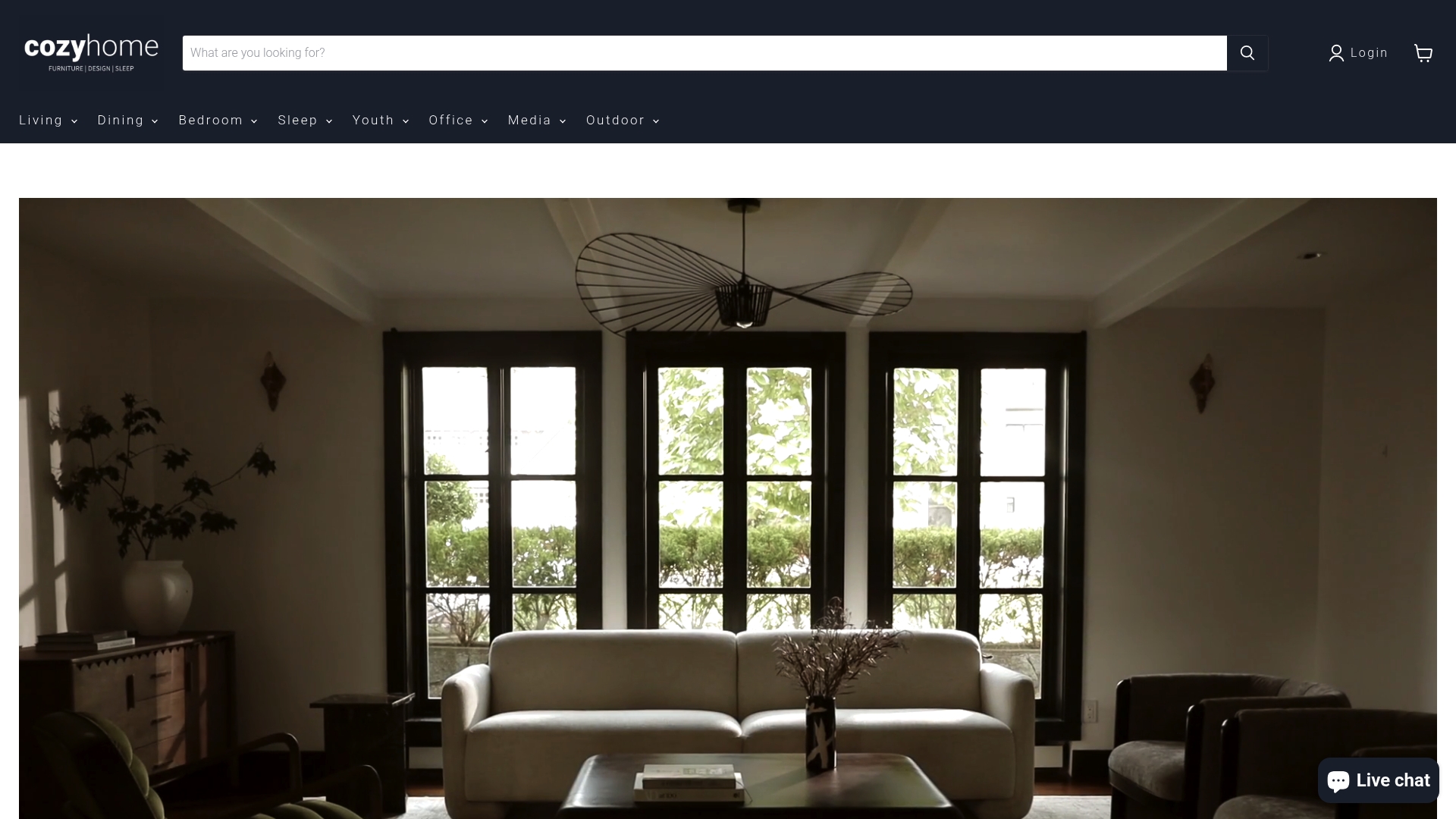
If you’re weighing a custom sofa or sectional against something mass-produced, the frame underneath is worth more attention than the fabric on top. Solid, properly dried wood framing is also part of why solid wood goods hold up better than cheaper alternatives over years of daily use, the same principle that applies whether you’re buying a door or a sofa. Browse the Excelsior sofa in cream or the Excelsior sofa in gray to see the construction firsthand, or visit a showroom to learn about the frame, fabric options, and how the piece fits your space before making a decision.
Sources
- Wood Handbook — Chapter 12: Drying and Control of Moisture Content and Dimensional Changes — USDA Forest Products Laboratory
- Air-drying lumber from your own forest — University of Missouri Extension
- Fundamental aspects of kiln drying lumber — Oklahoma State University Extension
FAQ
What Is Kiln Dried Wood?
Kiln dried wood is lumber or firewood dried in a heated chamber to a controlled, tested moisture content, usually 6% to 8% for furniture and under 20% for firewood, rather than left to dry naturally outdoors.
What Are the Disadvantages of Kiln Drying Wood?
Kiln drying costs more than air drying because of energy and equipment, and rushed schedules can cause defects like surface checking or honeycombing if the process isn’t staged correctly.
Is Kiln-Dried Wood Better?
For indoor furniture and millwork, yes. Kiln-dried wood reaches moisture levels air drying can’t consistently achieve, which keeps joints tight and finishes stable in heated homes; for rough framing or outdoor projects, air-dried or lower-grade kiln-dried stock often works fine.
What Is Special About Kiln-Dried Wood?
Kiln drying uses controlled heat, humidity, and airflow in stages, including an equalization phase, to reach a precise target moisture content and kill pests and mold in the process, something open-air drying can’t reliably do.
Where Should I Buy Kiln-Dried Wood for a Furniture Project?
Sawmills with in-house kilns and specialty hardwood yards offer the most transparency about species and tested moisture content; for finished furniture, working with a shop like cozyhome furniture that documents the wood inside each piece removes the guesswork entirely.