

What Is Furniture Artisan Craftsmanship: A Clear Guide
Most people assume that newer manufacturing methods automatically produce better furniture. That assumption gets expensive fast. What is furniture artisan craftsmanship, really? It’s the practice of a skilled maker using traditional techniques, deep material knowledge, and careful attention to detail to build a piece that performs and looks better over decades, not just years. At cozyhome furniture, we’ve seen firsthand how artisan-made pieces outlast their mass-produced counterparts by a wide margin. This guide breaks down the principles, techniques, and real benefits so you can make smarter choices about what goes into your home.
Table of Contents
- Key takeaways
- What furniture artisan craftsmanship really means
- Traditional furniture making techniques that define the craft
- Benefits of choosing artisan-crafted furniture
- How to identify genuine artisan craftsmanship
- My take on why artisan craftsmanship still matters
- Explore artisan furniture at cozyhome furniture
- FAQ
Key takeaways
| Point | Details |
|---|---|
| Artisan craftsmanship defined | It combines traditional techniques, material mastery, and skilled handwork to produce furniture built for lasting quality. |
| Traditional joinery matters | Mortise-and-tenon joints create wood-to-wood connections that adjust with humidity and outlast metal fasteners. |
| Benefits go beyond looks | Artisan furniture offers superior durability, unique character, sustainability, and emotional value that mass production cannot replicate. |
| Spotting genuine craftsmanship | Look for visible joinery, natural wood grain use, hand-finished surfaces, and honest material labeling. |
| Investment mindset pays off | Artisan pieces transcend trends and become lasting style investments that hold up across generations. |
What furniture artisan craftsmanship really means
The word “artisan” gets used loosely in furniture marketing, so let’s ground it in something concrete. An artisan furniture maker is a skilled craftsperson who uses traditional techniques and material knowledge to produce pieces where function and beauty are both intentional outcomes. The process is slower, more deliberate, and governed by a deep understanding of how wood behaves over time.
What separates artisan craftsmanship from standard production is not just the tools used. It’s the mindset. A factory worker follows a repeatable process designed for speed and uniformity. An artisan reads the wood, responds to its grain and moisture content, and makes decisions that serve the long-term integrity of the piece. Handcrafted furniture offers uniqueness, superior durability, and a personal quality that machine-manufactured pieces simply cannot replicate.
Here’s what defines genuine artisan furniture skills in practice:
- Material mastery: The craftsperson selects wood based on grain direction, density, and natural movement, not just appearance.
- Joinery knowledge: Structural connections are made using time-tested methods that account for how wood expands and contracts with humidity changes.
- Hand finishing: Surfaces are sanded, shaped, and finished by hand to bring out the wood’s natural character rather than covering it up.
- Attention to proportion: Every dimension is considered in relation to how the piece will actually be used and how it will look in a room.
- Patience with process: Artisan furniture making takes longer because each stage is done thoughtfully, not rushed to meet a production quota.
Pro Tip: When shopping for furniture, ask the retailer specifically how the joints are constructed. If they can’t answer that question, the piece is almost certainly mass-produced.
Craftsmanship in furniture is also a form of problem-solving. Natural wood is never perfectly uniform, and an artisan works with those variations rather than against them. That approach produces pieces with genuine character. It also produces pieces that hold up.
Traditional furniture making techniques that define the craft
No single technique illustrates artisan craftsmanship better than mortise-and-tenon joinery. Understanding how it works explains a lot about why handcrafted furniture lasts so much longer than flat-pack alternatives.
How mortise-and-tenon joinery works
A mortise is a rectangular cavity cut into one piece of wood. A tenon is a shaped projection on the end of another piece that fits precisely into that cavity. When the two come together, the joint creates a wood-to-wood connection across a large surface area. Mortise-and-tenon joints resist twisting, pulling, and side pressure better than dowels or screws, and they have been doing so in furniture for thousands of years.
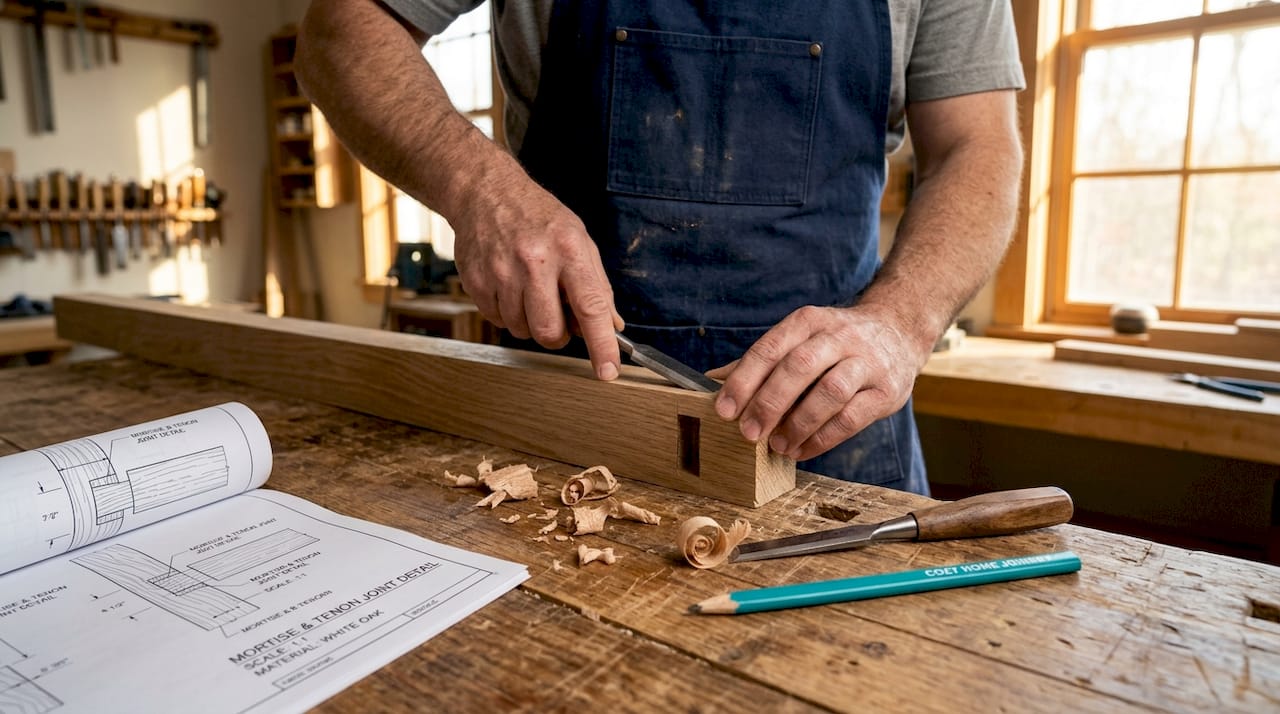
The reason this joint outperforms metal fasteners is not just strength. It’s flexibility. Wood expands when humidity rises and contracts when it drops. A screw or nail creates a fixed point that fights that movement, eventually cracking the surrounding wood. A well-fitted mortise-and-tenon joint moves with the wood, distributing stress rather than concentrating it. That’s why a well-made chair from a century ago still holds together while a flat-pack version from five years ago wobbles at the legs.
Comparing joinery methods
| Joinery method | Strength | Longevity | Adjusts to wood movement |
|---|---|---|---|
| Mortise and tenon | Very high | Generations | Yes |
| Dowels | Moderate | 10 to 20 years | Partially |
| Screws and brackets | Moderate | 5 to 15 years | No |
| Staples and glue | Low | 2 to 8 years | No |
It’s worth noting that moisture cycling can reduce joint strength over time unless the joinery is properly reinforced with dowels or quality wood glue. Skilled artisans account for this from the start, choosing wood species with stable grain and applying reinforcements where they will do the most good.
Hand tool use is another marker of genuine artisan technique. Andy Glenn, a craftsman in Maine, uses axes and drawknives to hand-shape chairs using Appalachian traditions that predate power tools. The result is furniture with surface texture and proportion that machines cannot reproduce. The process is slower, but the outcome is a piece with real identity.
Pro Tip: Run your hand along the underside of a chair or table leg. Machine-made pieces feel perfectly uniform. Artisan pieces often have subtle variations in surface texture that reflect the hand tool work. That variation is a feature, not a flaw.
Mortise-and-tenon joinery requires patience and respect for materials, and practicing it builds the foundational skills that define artisan craftsmanship. It’s not just a technique. It’s a commitment to doing the work properly.
Benefits of choosing artisan-crafted furniture
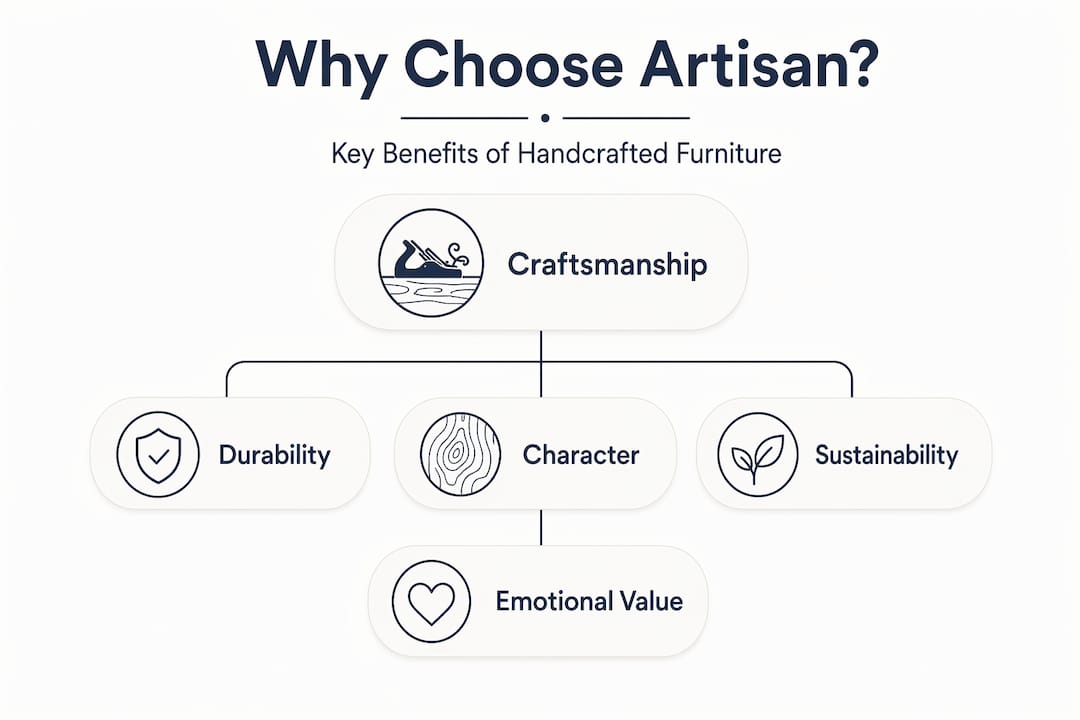
Understanding the benefits of handcrafted furniture goes beyond appreciating the skill involved. These are practical advantages that affect how your home looks and functions for years to come.
Durability that compounds over time. Mass-produced furniture is engineered to a price point, which usually means compromises in joinery, wood quality, and finish. Artisan furniture is engineered to last. The structural integrity of traditional joinery means a well-made dining table or sofa frame can serve multiple generations without needing replacement.
Unique character in every piece. Artisan-made pieces are one-of-a-kind in a way that factory furniture simply is not. Natural wood grain, hand-applied finishes, and the subtle marks of skilled handwork give each piece a specific identity. You are not buying one of ten thousand identical units. You are buying something made with individual attention.
Sustainability through skilled use of materials. Artisan furniture making wastes less wood because the craftsperson works with the material’s natural properties rather than forcing it into a standardized shape. Traditional joinery also means pieces can be repaired rather than discarded. A loose mortise-and-tenon joint can be re-glued. A stripped screw in a particle board frame usually means the piece is done.
Emotional and narrative value. There is real satisfaction in knowing that a person with genuine artisan furniture skills spent hours selecting, shaping, and finishing the piece in your living room. Craftsmanship creates functional yet artistic furniture that transcends trends and becomes a lasting style investment. That’s a different relationship with an object than you get from something pulled off a warehouse shelf.
The importance of artisan furniture becomes clearest when you compare a 10-year-old handcrafted piece to a 10-year-old mass-produced piece. One has developed character. The other has developed wobble.
How to identify genuine artisan craftsmanship
Knowing what to look for protects you from misleading marketing. The word “artisan” appears on a lot of furniture that doesn’t earn the label. Here’s how to tell the difference when you’re shopping.
-
Examine the joinery. Flip a chair upside down or look at the corners of a cabinet. Visible dovetail joints, mortise-and-tenon connections, or hand-cut finger joints are signs of genuine craftsmanship. Staples, cam locks, and plastic brackets are signs of mass production.
-
Look at how the wood grain is used. An artisan selects and orients wood so the grain runs in the direction that provides the most strength for each part of the piece. Random or mismatched grain patterns suggest the wood was cut for efficiency, not performance.
-
Check the finish quality. Hand-applied finishes show slight variation in sheen and depth. They feel different from the perfectly uniform spray finishes used in mass production. Look for surfaces that respond to light in a nuanced way.
-
Ask about the maker. Genuine artisan furniture comes with a story. The retailer should be able to tell you where it was made, by whom, and using what methods. Vague answers like “crafted with care” without specifics are a red flag.
-
Assess the weight. Solid wood furniture built with traditional joinery is heavier than furniture made from engineered wood or hollow components. Pick up a chair. If it feels surprisingly light, the construction is probably not what the label suggests.
Pro Tip: The phrase “solid wood construction” on a label does not always mean what you think. It can legally refer to furniture that uses solid wood only in visible areas, with engineered materials elsewhere. Ask specifically about the frame and joinery, not just the surface.
How to choose artisan furniture comes down to asking better questions and knowing what the answers should look like. Price is one signal, but it’s not the only one. Some genuinely artisan-made pieces are more affordable than you’d expect, especially when you buy directly from a maker or a showroom that sources carefully.
My take on why artisan craftsmanship still matters
I’ve spent years looking at furniture from both sides of the quality spectrum, and the thing that strikes me most is how quickly mass-produced pieces reveal their limitations. Not in the showroom. In your home, after two years of actual use.
What I’ve learned is that craftsmanship in furniture is not nostalgia. It’s engineering that has been tested across centuries rather than quarters. The mortise-and-tenon joint is not popular because it’s traditional. It’s traditional because it works better than the alternatives, and that remains true regardless of what manufacturing technology is available.
I’ve also noticed that people who own genuinely artisan-made pieces talk about them differently. They know the maker’s name. They know the wood species. They notice how the piece looks different in morning light versus evening light. That’s not a small thing. Your home is where you spend most of your life, and the objects in it shape how that life feels day to day.
The uncomfortable truth about furniture shopping is that most of us have been trained by big-box retail to think of furniture as disposable. We replace it every few years without questioning why it needed replacing. Artisan craftsmanship offers a different model. Buy less. Buy better. Keep it longer. That’s not just good for your home. It’s good for your budget over time, and it’s better for the environment.
If you’re considering a piece like the Walden parquet sofa table, look at how the wood pattern is constructed and how the joints are finished. Those details tell you everything about the level of care that went into it.
— Pecan
Explore artisan furniture at cozyhome furniture
At cozyhome furniture, we believe that furniture should be built around how you actually live, not pulled off a warehouse floor and shipped to whoever ordered first. Our Plano showroom carries pieces that reflect genuine craftsmanship in furniture, from solid wood accent tables to custom-configured sofas built with American-made quality.
Whether you’re looking for a statement accent table in walnut or a full dining setup with chairs that will hold up to real family use, we guide you through every choice. Our in-store team can explain exactly how each piece is constructed, what materials were used, and why those choices matter for long-term performance. Visit cozyhome furniture in Plano to see and feel the difference that real craftsmanship makes, or browse our curated collection online to start building a home that lasts.
FAQ
What is furniture artisan craftsmanship?
Furniture artisan craftsmanship is the practice of building furniture by hand using traditional techniques, skilled joinery, and deep knowledge of natural materials. It prioritizes long-term quality and individual character over speed and uniformity.
How is artisan furniture different from mass-produced furniture?
Artisan furniture is handcrafted by specialists using methods like mortise-and-tenon joinery, while mass-produced furniture relies on automated processes and engineered materials that prioritize cost efficiency over structural integrity.
Why is mortise-and-tenon joinery considered superior?
Mortise-and-tenon joints create wood-to-wood connections that adjust with humidity changes, resisting twisting and pulling far better than screws or dowels. This is why well-made artisan furniture can last for generations.
How do I spot genuine artisan craftsmanship in a store?
Look for visible traditional joinery, consistent grain direction, hand-applied finishes with natural variation, and a retailer who can tell you specifically where and how the piece was made.
Is artisan furniture worth the higher price?
Yes, when you factor in longevity. A well-crafted piece that lasts 30 to 50 years costs less per year than a mass-produced piece replaced every 5 to 10 years, and it holds its character and structural integrity throughout.