

How to Style a Transitional Home by Mixing Furniture Periods
The fastest way to make mixed-period furniture look intentional is to choose one anchor piece that sets the dominant style, then repeat two or three binding elements (a wood undertone, a metal finish, or a color) across every other piece in the room. That single habit is what separates a collected, layered home from one that just looks busy.
Before you rearrange a single chair, take three quick steps:
- Measure the room and note the square footage, ceiling height, and natural light direction.
- Choose your anchor — the sofa, dining table, rug, or statement antique that will carry roughly 80% of the room’s personality.
- Pick two repeating elements — one color family and one finish (wood tone or metal) that will appear in at least three places.
Pro Tip: Snap a photo of the room on your phone and squint at it. If one piece jumps out as unrelated to everything else, that’s your problem piece. A photo flattens the space and makes scale and color conflicts obvious in seconds.
Key Takeaways
A transitional home built on a clear anchor, repeated binding elements, and balanced scale will feel cohesive regardless of how many furniture periods it draws from.
| Point | Details |
|---|---|
| Anchor first | Choose one dominant piece and let it set the palette, scale, and style direction for the room. |
| 80/20 ratio | Keep one style at roughly 80% of the room; use the remaining 20% for era-specific contrast. |
| Repeat two or three elements | Repeat a color family, a wood undertone, and a metal finish across at least three pieces each. |
| Test before committing | Snap a photo or tape out a footprint before moving or buying any large piece. |
| cozyhome furniture | Made-to-order sofas and sectionals in 700+ fabrics let DFW homeowners match the exact undertone their transitional room needs. |
Table of Contents
- What is transitional style, and why does it work for mixing furniture periods?
- Core principles for mixing furniture periods so the result feels intentional
- Room-by-room tactics for a cohesive transitional interior
- How color, materials, and finishes unify mixed-period furniture
- How to update and integrate antiques or thrifted finds
- How lighting, rugs, and accessories pull a mixed room together
- Common mistakes when mixing furniture periods and how to fix them
- A 10-point quick audit and three edits you can make today
- cozyhome furniture makes the transitional mix easier for DFW homeowners
- The case for rooms that feel collected, not coordinated
- Sources
- FAQ
What is transitional style, and why does it work for mixing furniture periods?
Transitional design is the marriage of traditional and contemporary influences held together by a warm neutral palette and a careful balance of silhouettes. Think creams, tans, warm grays, and the greige tones that sit between beige and gray. Straight-lined, clean furniture profiles share space with softer, curved ones, and the result feels neither stiff nor trendy.
According to HGTV’s design guide, transitional interiors prioritize comfort and livability above all else. That’s exactly why the style handles mixed periods so well: it sits between the austerity of ultra-modern rooms and the ornate weight of strictly traditional ones, giving you room to layer.
Three characteristics make transitional design a natural home for blending eras:
- Neutral palette flexibility. Whites, creams, tans, and grays work with virtually any wood tone or upholstery color from any period.
- Silhouette balance. The style already calls for mixing straight and curved profiles, so a Queen Anne chair next to a clean-lined sofa reads as intentional rather than accidental.
- Texture layering. Organic materials like linen, leather, and natural wood are common in transitional rooms, and they appear across furniture periods without looking out of place.
For a deeper look at transitional aesthetics and palette choices, the balance of restraint and warmth is what keeps these rooms feeling fresh year after year.
Core principles for mixing furniture periods so the result feels intentional
Getting a mixed-period room right comes down to a handful of repeatable rules. Apply them consistently and the result looks curated. Skip them and the room looks like a storage unit.
The anchor piece
Every successful mixed room starts with one dominant piece that sets the tone. It can be a sofa, a dining table, a vintage rug, or a statement antique. According to Havenly’s designer guidelines, the anchor should be relatively neutral so it gives you permission to be bolder with accent pieces. A quiet, well-proportioned sofa in cream or warm gray lets an ornate antique side table read as a deliberate choice rather than a leftover.
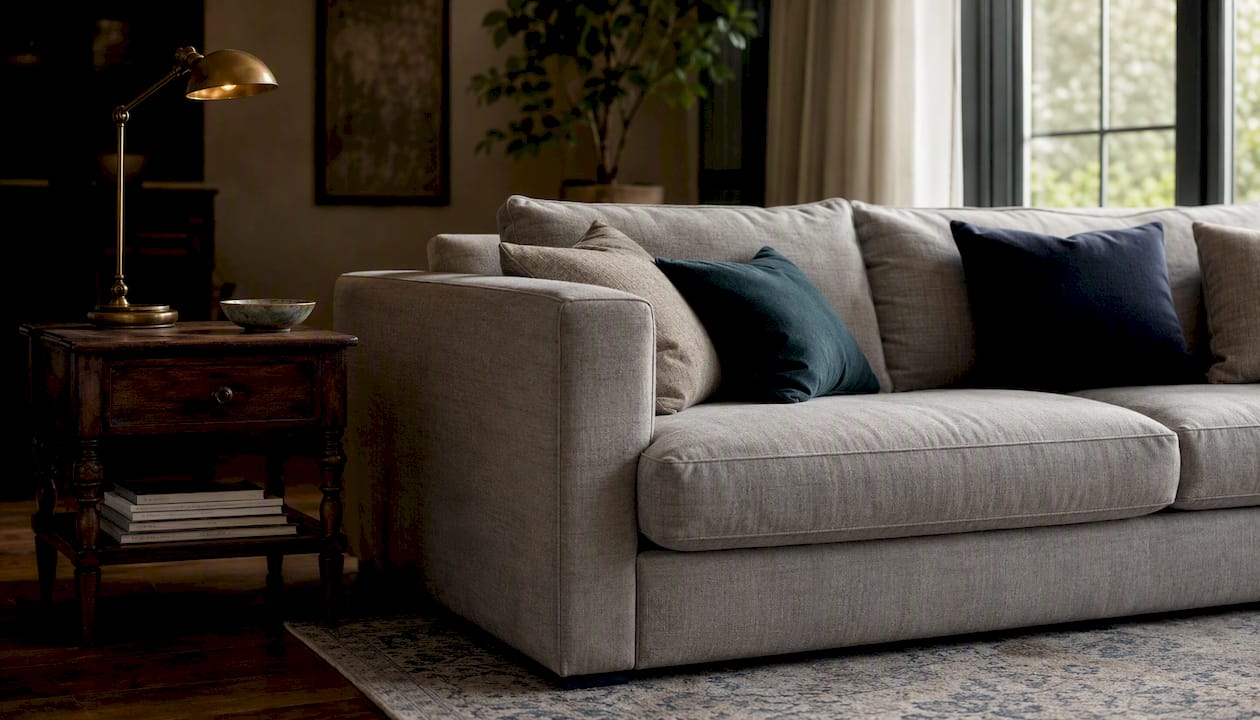
Knowing how to choose a statement piece is the single most useful skill in transitional decorating, because the anchor controls every decision that follows.
The 80/20 rule
Nordic Design Blog’s mixing guidelines recommend making one style dominant in most of the room, with a smaller proportion reserved for contrast. In practice, this means if your anchor and most of your seating lean contemporary, your accent chairs, side tables, and art can carry traditional or vintage character. Flip the ratio and the room still works — a traditional dining table with modern chairs is a classic pairing — but pick a ratio and commit to it.
Repetition
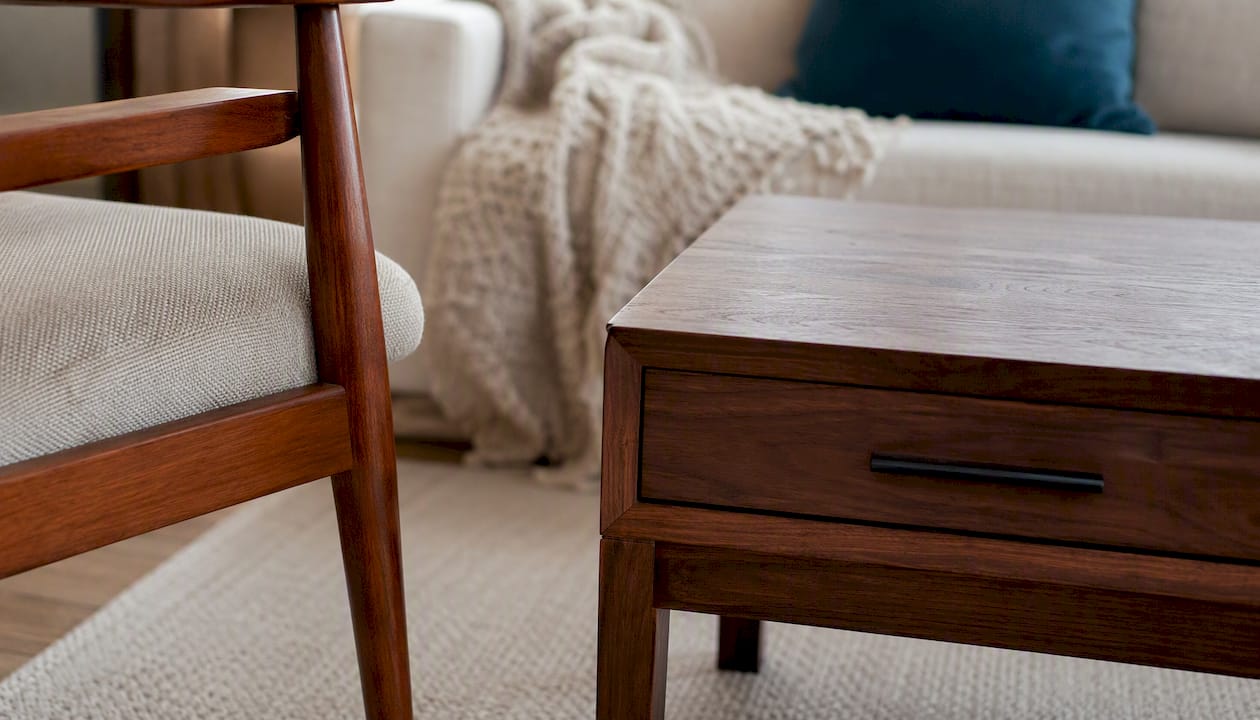
Repeat two or three elements across the room: a color, a metal finish, a wood undertone, or a silhouette detail. MyDomaine’s mixing guide specifically calls out undertones — warm creams and honeyed woods pair naturally, while mixing warm and cool undertones requires repeating each at least twice so neither reads as a mistake.
Scale and proportion
Scale mismatches are the most common reason a mixed room feels wrong. Before buying any new piece, tape out its footprint on the floor and live with it for a day. A piece that looks right in a showroom can overwhelm a room or disappear in it once it’s home.
The checkpoint method
Architectural Digest describes a practical checkpoint: choose three cherished items in the room and require every new piece to share at least one unifying characteristic with one of them. It prevents impulse buys from breaking the mix.
Designer’s pre-purchase checklist:
- Does this piece share a color, finish, or material with my anchor?
- Does it fit the scale of the other pieces in the room?
- Does it push the dominant style past 80%, or does it add useful contrast?
- Have I taped out its footprint and confirmed circulation still works?
- Does it repeat or introduce a silhouette already present in the room?
Pro Tip: Livingetc’s 2026 editorial frames updated rules for transitional styling around proportion and curated layering. If a piece passes the checkpoint but still feels off, the issue is almost always scale or undertone mismatch, not style.
Room-by-room tactics for a cohesive transitional interior
Living room
The sofa is almost always the right anchor here. Choose a clean-lined profile in a neutral fabric — cream, warm gray, or tan — and let accent chairs carry more personality. A vintage rug under a contemporary sofa immediately sets the tone and makes smaller, mixed pieces read as deliberate. For lighting, a modern pendant or sculptural floor lamp above a traditional seating group creates the contrast that defines transitional rooms.
Common living room pitfalls:
- Placing two visually heavy anchor pieces (a large sectional and a massive antique armoire) on the same wall
- Choosing accent chairs so different in scale they look borrowed from another room
- Forgetting to repeat the metal finish from the coffee table legs to the lamp base
Dining room
The dining table is your anchor. A farmhouse table with modern upholstered chairs is one of the most reliable transitional combinations because the table carries warmth and the chairs carry restraint. A modern chandelier above a traditional table is the classic “puncture” move that HGTV’s transitional guide recommends — it updates the room without replacing anything.
- Start with the table shape and finish.
- Choose chairs that repeat one element from the table (leg finish, wood tone, or upholstery color).
- Add a light fixture that contrasts the table’s era but shares its scale.
Bedroom
The bed frame is the anchor. A traditional upholstered headboard in a neutral linen works with both modern and vintage nightstands. Layer textiles — a contemporary duvet, a vintage-style quilt folded at the foot, linen shams — to connect periods through texture rather than matching sets. Mismatched nightstands are fine as long as they share a finish or a height.
Entry
Scale matters most here because entries are small and first impressions are fast. A console table with clean lines under an ornate vintage mirror is a reliable pairing. Keep the floor clear for circulation and let one statement piece do the work rather than crowding the space.
How color, materials, and finishes unify mixed-period furniture
Color is the fastest unifier in a mixed room. A neutral living room palette built on warm whites, creams, and greige tones gives pieces from different eras a shared background. Add one accent color — a dusty blue, a terracotta, a forest green — in small doses through pillows, art, or a single upholstered chair.
Wood undertones: Warm woods (walnut, oak with amber stain, cherry) pair naturally with each other. Cool woods (ash, maple, gray-washed oak) form their own family. Mixing warm and cool is possible, but MyDomaine recommends scattering different wood finishes around the room rather than grouping them, so each reads as a deliberate accent rather than a mismatch.
Metal finishes: Choose one or two metal families and repeat them. Unlacquered brass and matte black is a popular transitional pairing because brass reads warm and traditional while black reads clean and contemporary. Brushed nickel and bronze is another. The rule is simple: if a third metal appears, it needs to echo one of the first two.
Do/don’t pairs to keep in mind:
- ✓ Warm greige walls + walnut table + cream linen sofa
- ✓ Brass hardware + warm oak floors + ivory upholstery
- ✗ Cool gray sofa + warm honey oak table + chrome fixtures + antique gold mirror (four competing undertones)
- ✗ Three different wood tones grouped on one wall with no repetition elsewhere
Pro Tip: The benefits of a neutral home palette go beyond aesthetics — neutral walls and floors make it easier to swap accent pieces seasonally without repainting or replacing anchors.
How to update and integrate antiques or thrifted finds
Antiques and vintage pieces add the character that makes a transitional room feel collected rather than purchased all at once. The challenge is keeping them from feeling dated or out of place.
Decision flow for any vintage piece:
- Keep as-is if the piece’s finish and scale already work with the room’s palette and proportions.
- Restore or refinish if the bones are right but the color or finish clashes. A dark mahogany side table can be lightened with a whitewash or painted in a neutral that ties it to the room.
- Reupholster if the frame is strong but the fabric is worn or the color is wrong. The Spruce’s antique integration guide notes that refreshing the batting and springs while reupholstering delivers modern comfort without losing the piece’s original character.
Scale and placement rules for antiques:
- Place heavy, visually dense antiques near walls to reduce their dominance in the center of the room.
- Use leggy, open-frame vintage pieces (a cane chair, a slender console) in the middle of a space where they won’t block sightlines.
- Spread patina and texture through the room rather than grouping all the antiques in one corner.
Pro Tip: When sourcing replacement fabric for a reupholstery project, bring a photo of your anchor piece to the fabric store. Choose a fabric that repeats one color from the anchor and one texture already present in the room — linen, leather, or a woven — so the refreshed piece slots in rather than stands out. For statement vintage pieces that need a stronger update, a full paint and reupholster combination is often the most cost-effective path.
How lighting, rugs, and accessories pull a mixed room together
Secondary elements do more work than most homeowners expect. A rug or a light fixture can translate between two pieces that have nothing else in common.
Rugs as anchors and translators. A large vintage or antique rug under a clean-lined contemporary sofa is one of the most reliable moves in transitional decorating. The rug introduces warmth, pattern, and age while the sofa keeps the room from feeling heavy. The mix reads as intentional because the rug is clearly the dominant texture.
Lighting as a bridge. A modern chandelier in a traditional dining room, or a sculptural floor lamp beside a vintage armchair, creates the contrast that defines the transitional look. The fixture doesn’t need to match the furniture’s era; it needs to share a finish or a scale with something else in the room.
Accessories as repeating elements:
- Scatter the same metal finish (brass, black, bronze) across lamps, picture frames, and hardware rather than concentrating it in one spot.
- Use woven textiles (a jute basket, a linen throw, a rattan tray) to add organic texture that reads naturally across periods.
- Group accessories in odd numbers and vary their heights — a tall lamp, a medium vase, a low tray — so the eye moves rather than stops.
The lowest-cost test for any bridging solution: swap a lamp, change the pillow grouping, or move a piece of art before committing to a larger purchase. These small swaps reveal whether a room needs a new element or just a rearrangement of what’s already there.
Common mistakes when mixing furniture periods and how to fix them
| Mistake | Impact | Fix |
|---|---|---|
| No anchor piece | Room feels random, no visual hierarchy | Choose one dominant piece and let everything else support it |
| Scale mismatch | One piece overwhelms or disappears | Tape out footprints; match visual weight across pieces |
| Palette drift | Too many competing colors or undertones | Return to a two-color family; remove pieces that introduce a third |
| Too many focal points | Eye doesn’t know where to land | Edit accessories down; keep one statement per wall |
| Grouped antiques | One corner reads as a museum, the rest as a showroom | Spread vintage pieces across the room to distribute patina |
| Unrelated metal finishes | Room feels unresolved | Limit to two metal families; repeat each at least twice |
Avoiding common furniture shopping mistakes before you buy saves more time than fixing them after delivery.
A 10-point quick audit and three edits you can make today
Run through this checklist in any room that feels off:
- Is there a clear anchor piece that reads as dominant?
- Does the anchor share a color or finish with at least two other pieces?
- Are all wood tones either warm or cool (or repeated if mixed)?
- Are metal finishes limited to two families, each appearing at least twice?
- Have you taped out or measured every large piece against the room’s square footage?
- Does the rug cover at least the front legs of all seating?
- Is there one clear focal point per wall, not two or three competing ones?
- Is there enough negative space for comfortable circulation (at least 36 inches between major pieces)?
- Does the lighting fixture share a finish or scale with something else in the room?
- Have you edited accessories down to groups of three or five, varying heights?
Three edits you can make today without spending much:
- Swap a lamp. Replace a lamp that doesn’t share a finish with anything else in the room. A brass or matte black base costs less than $80 at most home stores and immediately ties the room together.
- Change the pillow grouping. Pull pillows in two colors only: one from the anchor piece’s palette and one accent. Remove everything else.
- Tape out a new furniture footprint. If a piece feels wrong, tape its outline on the floor and live with it for 48 hours before moving it or replacing it.
Prioritize edits by cost and impact: accessories first (lowest cost, high visibility), then lighting, then upholstery, then furniture replacement.
cozyhome furniture makes the transitional mix easier for DFW homeowners
Pulling a transitional room together is much simpler when the anchor piece is built around your space rather than pulled off a warehouse floor. cozyhome furniture’s Plano showroom offers made-to-order sofas, sectionals, and accent pieces with 700+ fabric and leather options, so you can match the exact undertone your room needs rather than settling for what’s in stock.
The Excelsior Sofa in Cream is a clean-lined, neutral anchor that works with both traditional and contemporary accents. The Excelsior in Gray suits cooler palettes. For larger living rooms, the Form Lounge Modular Sectional in Sonoran Tan offers flexible configuration so the footprint fits your actual floor plan. The Wyatt Leather Bench in Beige works as a low-profile accent that translates between a traditional bed frame and a modern dresser.
In-store design staff at the Plano showroom guide you through fabric selection, sizing, and configuration. Free local delivery covers Plano, Frisco, Allen, McKinney, and surrounding DFW communities. Visit the showroom or browse the full sofa collection at Cozyhomefurniture to find the anchor piece your transitional room needs.
The case for rooms that feel collected, not coordinated
There’s a version of transitional decorating that gets misunderstood. People assume it means buying a matching set in a neutral color and calling it done. What it actually means is choosing pieces you genuinely love from different periods and giving them enough common ground to coexist.
The homes that feel the most comfortable are rarely the ones where everything matches. They’re the ones where a worn leather chair sits next to a clean linen sofa, where a grandmother’s side table holds a modern lamp, where the rug is older than the house. That kind of room takes time to build, and it should. Choosing furniture for the way you actually live means prioritizing comfort and longevity over trend cycles. Transitional style, done well, is the opposite of trendy. It’s the design approach most likely to still feel right in fifteen years.
Sources
These are the references we drew on most heavily for this guide:
- Transitional Design: Everything You Need to Know | Architectural Digest
- Transitional Design Style 101 | Everything You Need to Know About Transitional Design | HGTV
- How to Mix Modern and Antique Furniture
- How to create a cohesive home decor with transitional and …
- The Art of Mixing Furniture Styles: Cohesive Interior Design
- How to Mix Furniture Styles: 7 Rules Designers Swear By
- The 6 New Rules of ‘Transitional Style’ To Live by at Home | Livingetc
FAQ
What is transitional furniture style?
Transitional style blends traditional and contemporary influences using a warm neutral palette (creams, tans, warm grays) and a balance of straight and curved silhouettes. It prioritizes comfort and livability over strict adherence to any single design period.
What is the 3-5-7 rule in interior design?
The 3-5-7 rule is a grouping guideline: arrange accessories in odd numbers (3, 5, or 7 items) and vary their heights so the eye moves naturally across the group. It prevents flat, symmetrical arrangements that can make a room feel staged rather than lived-in.
Which furniture styles pair well with transitional?
Traditional, mid-century modern, and Scandinavian pieces all work well in a transitional room because each shares at least one characteristic (neutral palette, organic material, or clean silhouette) with the transitional base. The key is repeating a finish or color between the transitional anchor and the accent piece.
Is transitional design outdated?
No. Contemporary editorial coverage, including Livingetc’s 2026 guide, positions transitional as one of the most adaptable and enduring residential styles precisely because it isn’t tied to a single trend cycle. Its neutral base and layered approach make it easy to update with accessories without replacing anchor pieces.
How do you mix furniture periods without the room looking chaotic?
Start with a neutral anchor piece, apply the 80/20 rule to keep one era dominant, and repeat two or three binding elements (a color, a wood undertone, a metal finish) across every other piece in the room. The Architectural Digest checkpoint method — requiring each new piece to share at least one trait with a cherished existing item — keeps additions from breaking the mix.